Telescopic Mast
- Home
- Telescopic Mast
Telescopic Mast
Our Telescopic Masts are designed for reliable elevation of antennas, sensors, cameras, and surveillance equipment in the toughest terrains. Built with lightweight yet durable materials, they provide quick deployment, ease of transport, and dependable stability in field operations.
Pneumatic Type
- Operates using compressed air for smooth, quick elevation.
- Lightweight, easy-to-carry design with rapid deployment capability.
- Ideal for mobile communication systems, field surveillance, and temporary command posts.


Winch Type
- Manual or motorized winch-driven extension for precise height adjustment.
- Rugged and simple to operate, making it reliable in remote locations.
- Commonly used for defence radars, telecom equipment, and mining operations.
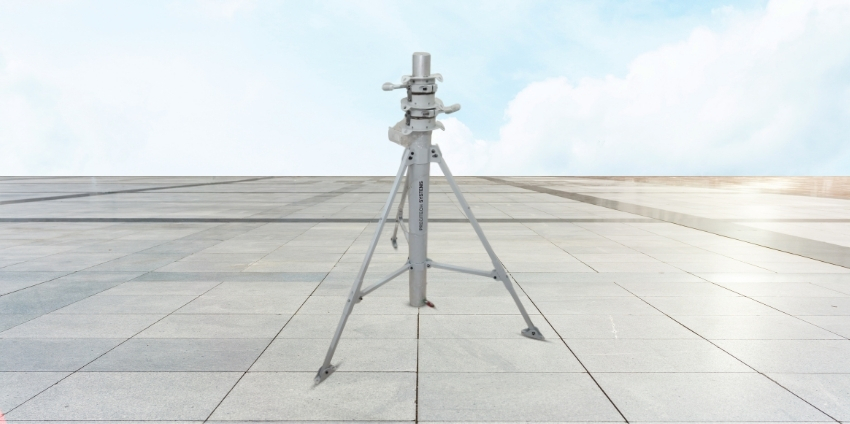
Electromechanical
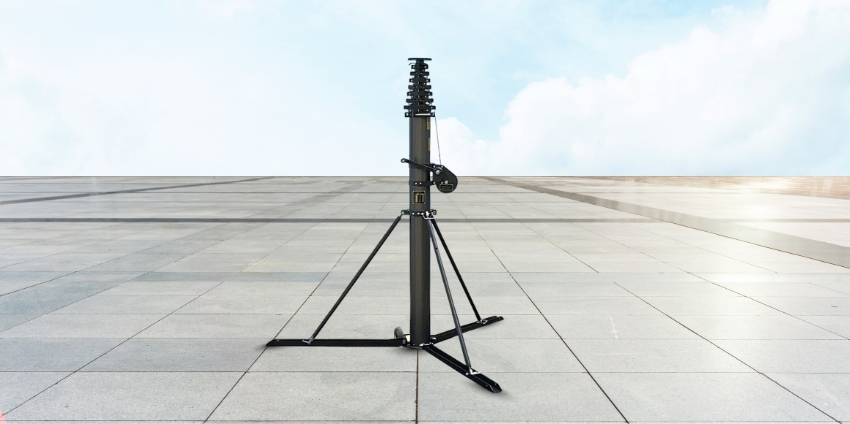
- Compact, portable tripod-based mast with motorized elevation.
- Provides stability and ease of operation in field conditions.
- Suitable for tactical applications such as UAV ground stations, camera systems, and portable radar setups.


Tripods
- Compact, portable tripod-based mast with motorized elevation.
- Provides stability and ease of operation in field conditions.
- Suitable for tactical applications such as UAV ground stations, camera systems, and portable radar setups.
Frequently Asked Questions
Answers for Telescopic Mast
Telescopic masts are widely used for communication antennas, surveillance systems, radar payloads, cameras, sensors, and mobile command applications. The choice between pneumatic, winch-driven, and electromechanical masts depends on factors such as deployment speed, payload capacity, operating environment, mobility requirements, and available power sources.
Pneumatic Masts
Pneumatic masts use compressed air to extend telescopic sections.
Advantages:
- Rapid deployment and retraction
- Smooth and quiet operation
- Suitable for frequent deployment cycles
- Minimal operator effort
- Well-suited for surveillance and communication applications
Typical Applications:
- Mobile communication systems
- Surveillance vehicles
- EO/IR camera systems
- Defense and homeland security platforms
Considerations:
- Requires an air compressor or compressed air source
- Periodic maintenance of pneumatic components may be required
Winch-Driven Masts
Winch-driven masts are extended and retracted using a manual or powered winch mechanism.
Advantages:
- Simple and cost-effective design
- Does not require compressed air or dedicated electrical drives
- Suitable for remote locations with limited infrastructure
- Lower maintenance requirements
Typical Applications:
- Communication antennas
- Temporary installations
- Field deployments with moderate payloads
Considerations:
- Slower deployment compared to pneumatic systems
- May require more operator involvement
- Generally preferred for lighter to medium-duty applications
Electromechanical Masts
Electromechanical masts use electric motors and drive mechanisms to extend and retract mast sections.
Advantages:
- Precise and controlled deployment
- High repeatability and positioning accuracy
- Remote operation capability
- Suitable for automated and integrated systems
- Can support demanding operational requirements
Typical Applications:
- Radar systems
- Advanced surveillance platforms
- Mobile command and control centers
- High-value communication and sensor systems
Considerations:
- Requires electrical power for operation
- More sophisticated control and drive systems
Which Mast Type is Best?
There is no universally "best" mast type. The optimal choice depends on the mission profile and operational requirements.
| Requirement | Pneumatic | Winch-Driven | Electromechanical |
|---|---|---|---|
| Deployment Speed | Excellent | Moderate | Excellent |
| Ease of Operation | High | Moderate | High |
| Remote Operation | Limited | Limited | Excellent |
| Precision Control | Moderate | Moderate | Excellent |
| Infrastructure Requirement | Air Supply | Minimal | Electrical Power |
| Automation Capability | Moderate | Low | High |
At Precitech Systems, all three technologies are offered depending on customer requirements and application needs. The selection process typically considers:
- Payload weight and center of gravity
- Required deployment height
- Wind loading conditions
- Frequency of deployment
- Vehicle or shelter integration requirements
- Power and utility availability
- Operational environment
The most effective mast is not necessarily the tallest or most advanced; it is the one that provides the required stability, reliability, and operational efficiency for the specific mission.
Vehicle-mounted applications place unique demands on telescopic mast systems. Unlike fixed installations, these systems must withstand transportation loads, deploy quickly in the field, operate reliably in varying environments, and safely support payloads such as antennas, cameras, sensors, radar systems, and communication equipment.
The most suitable mast depends on the mission profile, payload requirements, deployment frequency, and available utilities on the vehicle.
Pneumatic Masts
Pneumatic masts are among the most commonly used solutions for vehicle-mounted applications.
Best suited for:
- Communication vehicles
- Surveillance vehicles
- Mobile command centers
- EO/IR camera systems
Advantages:
- Fast deployment and retraction
- Smooth operation with minimal operator effort
- Proven performance in mobile applications
- Compact integration within vehicle platforms
Where an onboard compressor is available, pneumatic masts often provide an excellent balance of speed, reliability, and ease of use.
Electromechanical Masts
Electromechanical masts are increasingly preferred for advanced vehicle-mounted systems requiring automation and precise control.
Best suited for:
- Radar systems
- Integrated surveillance platforms
- Mobile command and control vehicles
- Automated communication systems
Advantages:
- Push-button deployment
- Remote operation capability
- Precise height control and positioning
- Integration with vehicle electronics and control systems
These masts are particularly attractive where operator convenience, repeatability, and automation are important.
Winch-Driven Masts
Winch-driven masts are suitable for certain vehicle-mounted applications where simplicity and lower infrastructure requirements are priorities.
Best suited for:
- Light-duty communication systems
- Temporary deployments
- Cost-sensitive projects
Advantages:
- Simple design
- Minimal utility requirements
- Easy maintenance
However, they are generally less suitable for applications requiring frequent deployment or rapid operational readiness.
Factors to Consider Before Selection
The right mast should be selected based on:
- Payload weight and dimensions
- Required operating height
- Wind load requirements
- Deployment frequency
- Vehicle size and available installation space
- Power and utility availability
- Level of automation required
- Environmental and operational conditions
At Precitech Systems, vehicle-mounted mast solutions are typically engineered as part of the complete platform rather than treated as standalone products. Factors such as vehicle dynamics, structural integration, cable routing, power systems, communication equipment, and operator ergonomics are considered during system design.
For most vehicle-mounted communication and surveillance applications, pneumatic and electromechanical masts are generally the preferred options due to their deployment speed, operational convenience, and suitability for repeated field use.
The best vehicle-mounted mast is ultimately the one that integrates seamlessly with the platform and delivers reliable performance throughout the mission lifecycle.
When evaluating telescopic mast manufacturer in India, the right choice depends on the application rather than just the mast height.
For defence, surveillance, communication, radar, EO/IR payloads, and mobile command systems, key parameters should include:
- Structural stability under wind loads
- Payload carrying capability at full extension
- Deployment and retraction time
- Vehicle integration expertise
- Customization capability for specific payloads
- Proven field performance and after-sales support
- Indigenous design and manufacturing capability
India has a few established players in the mast and mobility domain. However, many suppliers focus primarily on standard mast products, while specialized applications often require significant engineering customization. At Precitech we do customized prototyping and development of Masts for various customers and uses.
Unlike suppliers that primarily assemble or import mast systems, Precitech designs and manufactures telescopic mast solutions in-house and supports complete system integration for defense, homeland security, telecom, and industrial applications. Our capabilities extend beyond the mast itself to vehicle integration, power systems, communication shelters, surveillance payload mounting, and turnkey solutions.
What differentiates a good mast manufacturer is not just the ability to provide a 10 m, 20 m, or 30 m mast, but the engineering expertise to ensure the payload remains stable, deployable, and reliable in actual field conditions.
Before finalizing a supplier, always ask for:
- Payload vs height performance curves
- Wind load performance data
- Azimuth retention and pointing accuracy
- Deployment and retraction speed
- Cable management and RF integration capability
- Vehicle, shelter, or trailer integration options
- Lifecycle reliability and maintenance requirements
- Deployment life cycle
- Previous defence or critical infrastructure deployments
- Service and support capability
The best telescopic mast supplier is ultimately the one that can deliver a complete, application-ready solution with post deployment support and warranty, rather than just a mast assembly.
Precitech has proven record of manufacturing various customized solutions for Tier1 OEMs of India Defence, Mining, Telecom and Railways.
We can proudly say we have achieved high credibility of designing and producing large scale Telescopic Masts, Pneumatic Mast, Electro-Mechanical Mast, Surveillance Mast, Communication Mast, Mobile Defence Mast Solutions as leading Indigenous Mast Manufacturers.
Globally, communication networks rely on pneumatic, electro-mechanical, and manual telescopic mast systems for rapid deployment and elevated communication links. Leading mast manufacturers emphasize payload capacity, stability, and application-specific customization rather than simply offering standard mast heights.
In the Indian market, organizations evaluating communication mast solutions should look beyond catalogue specifications. A communication mast is only one part of the system. The real challenge lies in ensuring that antennas, microwave equipment, radio systems, LTE/5G nodes, or tactical communication payloads continue to perform reliably in field conditions.
This is where Precitech Systems brings significant value. Precitech designs and manufactures customized telescopic mast systems and supports complete communication solutions including:
- Vehicle-mounted communication systems
- Mobile command and control shelters
- Tactical communication platforms
- Surveillance and communication integration
- Defense and homeland security applications
- Customized mast solutions for specific payloads
Unlike suppliers offering standard off-the-shelf products, Precitech's strength lies in engineering masts around the communication payload, operating environment, and deployment concept.
Before selecting a communication mast supplier, always ask for:
- Payload vs. height performance data
- Wind load and deflection characteristics
- RF cable routing provisions
- Communication payload integration experience
- Field deployment references
- Long-term service support capability
The most effective telescopic mast for communication applications is not necessarily the tallest mast-it is the one that delivers reliable communication performance, rapid deployment, and operational stability throughout its service life.
Precitech ensures all that and beyond!